
Step 3 of 5 · Conversion
Dynamic paywalls and offer pages: how to show the right offer to every reader
Most paywalls and offer pages treat every reader the same way. A first-time visitor from Google, a regular who reads you every morning and a former subscriber all hit the same wall, with the same message and the same offers. It's the simplest set-up, and it's the one that leaves the most conversions on the table.
A dynamic paywall adapts to the reader. In Audiencers' guide to segmenting audiences for a dynamic paywall, it's defined as a paywall that changes its design, message or the journey, including whether it appears at all, depending on who is reading and in what context. And dynamic doesn't have to mean AI: most dynamic paywalls are rule-based, like showing a different paywall to someone reading about politics than to someone reading about sport.
This article looks at what publishers have learned from making their paywalls dynamic, how you can adapt yours, how to apply the same logic to your offers page, and how to build it all with Poool.
What publishers have learned
- Spektrum der Wissenschaft (Germany): testing walls with one, two and three offers across the four engagement groups of its dynamic paywall, a single offer performed worst in every segment, and three offers with a highlighted "best offer" in the middle performed best for the general audience. Addressing readers coming from Facebook with the informal "Du" almost doubled their click-through rate.
- Handelsblatt (Germany): showing all four of its offers on the paywall, at the moment readers just want to read the article, held conversion back. It moved to a single default offer, and only shows the Premium offer to readers with a high likelihood to subscribe. Conversion rose significantly, and each segment is now judged on the long-term revenue it brings, not just its conversion rate.
- Jeune Afrique (pan-African): its audience spans dozens of countries with very different payment habits. It segmented readers by engagement and by country, and adapted the currency, payment methods and message for each. One lesson: low-cost offers tested in lower-converting markets failed, because those readers preferred longer, annual offers.
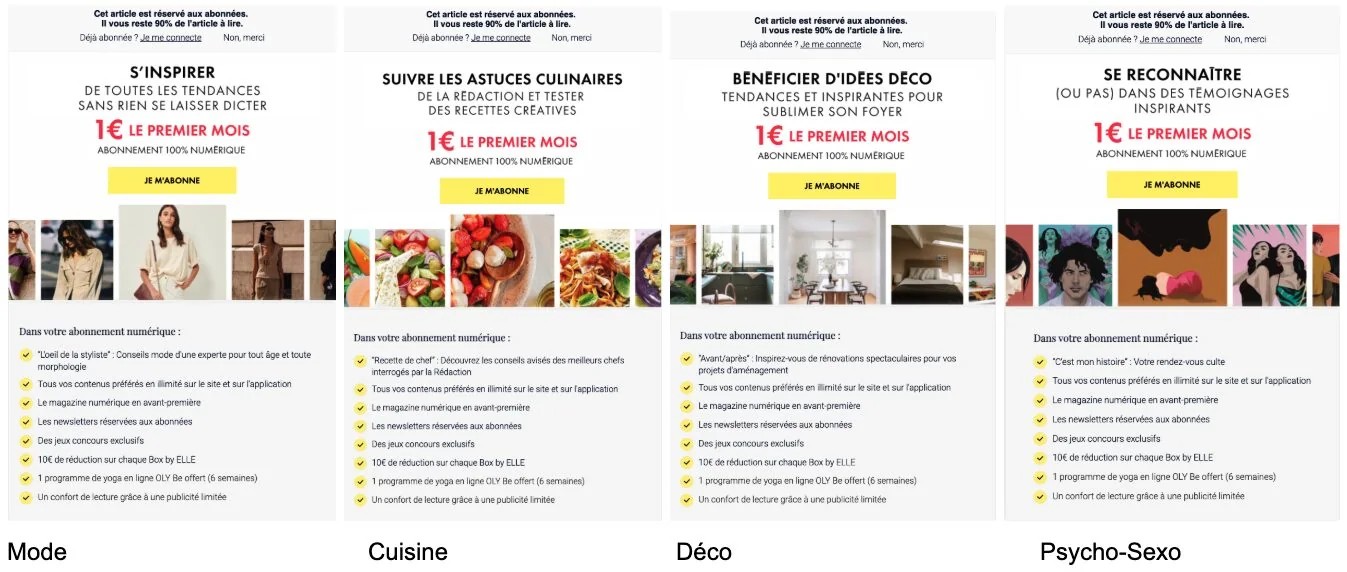
- ELLE.fr (France): contextual paywalls by section converted 50% better on average in three sections than its generic paywall.
The common thread: there is no single best paywall. There is a best paywall for each reader, and the only way to find it is to segment and test.
Three ways to segment your audience
Audiencers' guide groups the signals into three families:
- Content: free or premium, topic or section, user need, publication date.
- Reader profile: engagement level, status (anonymous, registered, newsletter subscriber, former subscriber), location.
- Acquisition channel: search, social media, newsletter, direct.
Combine them and you can decide, for each page view, what to show, how to say it and what to offer.
1. Adapt the message to the content
A reader who chose a football article and a reader who chose a climate investigation aren't buying the same thing. Speak to what they're reading: the section's coverage, its journalists, what subscribers get in that area. Freshness matters too: some publishers lock their newest articles and open older ones under a meter.
With Poool, you can target paywalls by content type, section, page or your own content variables, and mix blocking strategies by content type. Using Poool, ELLE.fr raised its paywall conversion rate by 20% with contextual paywalls by section.
2. Adapt to engagement
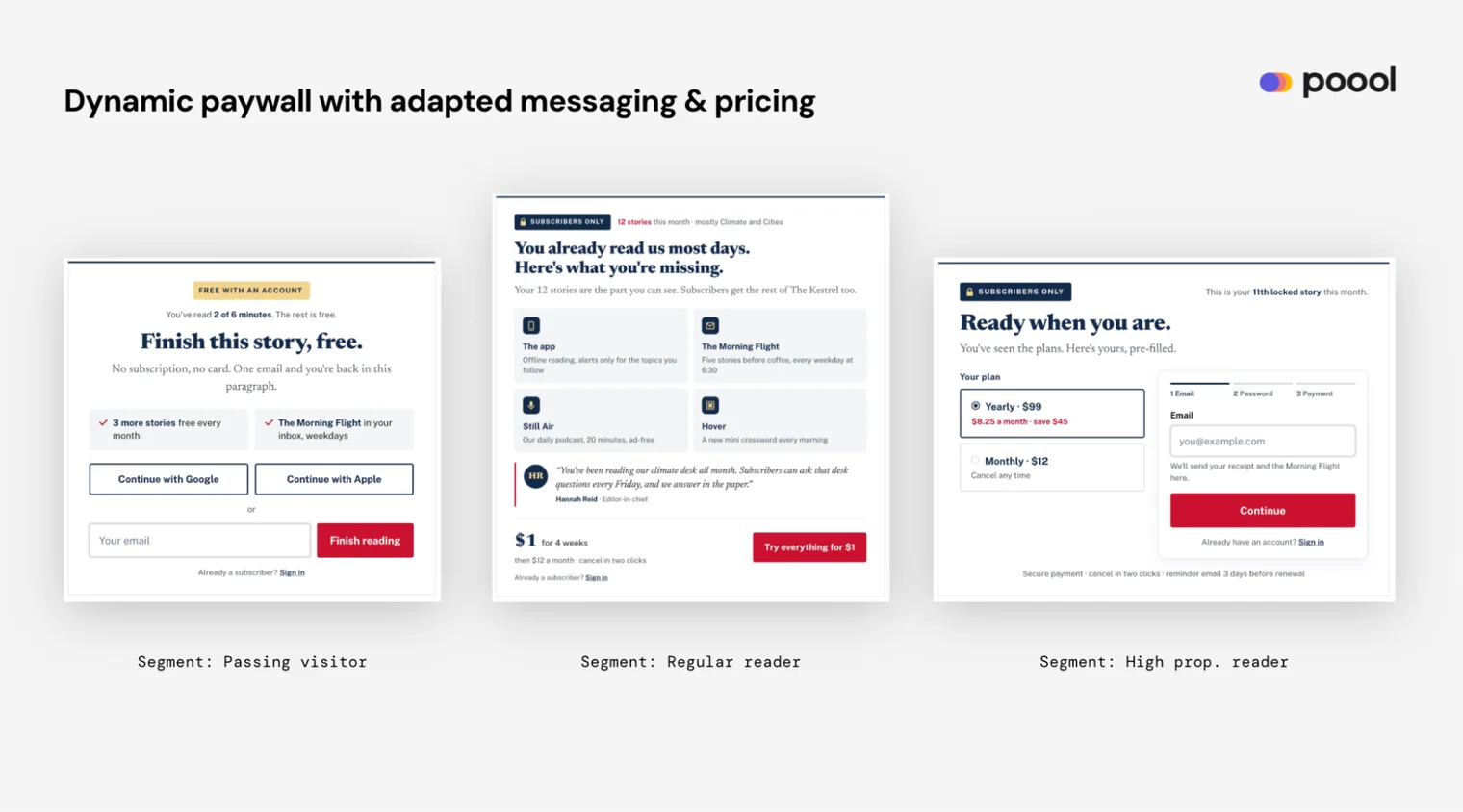
Low-engagement readers don't know you well yet: tell them who you are and why your journalism matters. Engaged readers already know: show them what subscribers get. For readers with a low likelihood to subscribe, a registration wall can be a better first step than a paywall.
With Poool, you can target by visits, articles read, time on page or scroll, use Poool's engagement segments, or bring your own score.
We built this on our fictional media, The Kestrel, with adapted messaging and pricing for our 3 engagement groups:
3. Adapt to location
Currency, prices, payment methods and local events all change by country or region. For international and regional publishers, the same paywall everywhere means the wrong price or the wrong payment option for many readers.
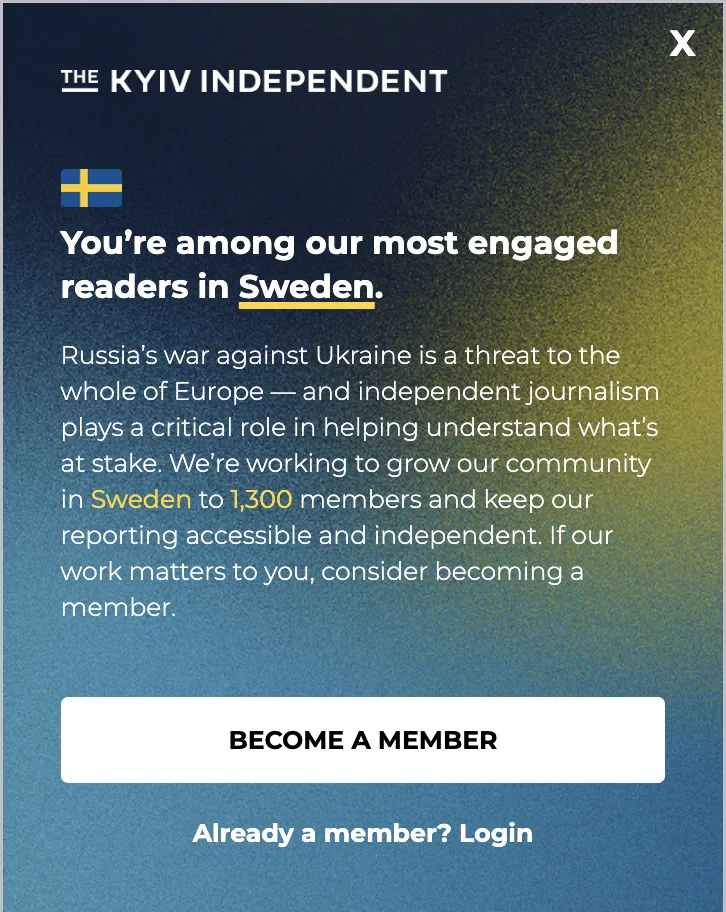
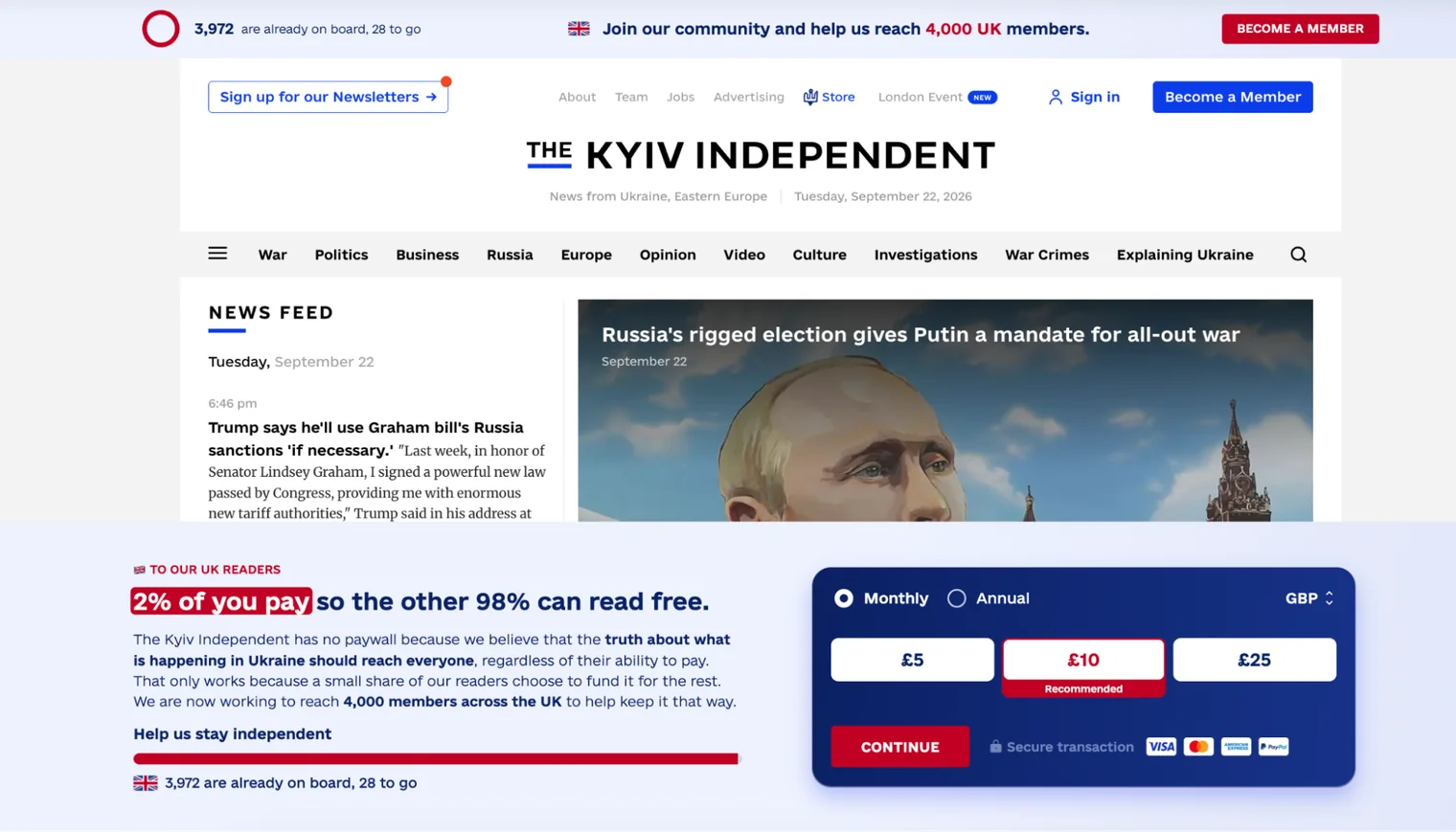
With Poool, you can show different offers and prices by country, for example, and adapt the message to each market. The publisher sets the offers and prices; Poool shows the right one to each reader. The Kyiv Independent runs some of its membership pushes with Poool Engage, targeted by location and engagement.
4. Adapt to where readers come from
A reader arriving from a search result, a social post or your newsletter is in a different frame of mind. Adapt the tone, as Spektrum did for Facebook readers, and the strength of the ask: some publishers use a harder wall for search traffic and a registration wall for social traffic. With AI assistants summarising the news, how you treat crawlers matters too.
With Poool, you can target by referrer, and choose your blocking strategy: a super hard paywall (nothing sent to Google or AI), a hard paywall with Googlebot whitelisted, a front-end soft paywall, or a mix by content type.
5. Adapt the offer
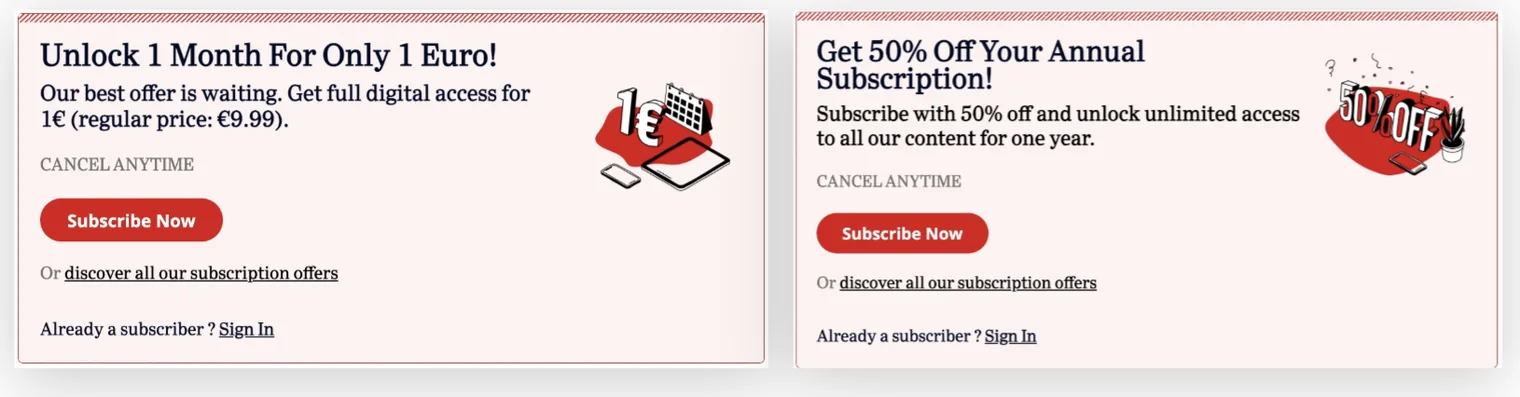
How many offers to show, which one to highlight, monthly or annual, with or without a trial: the right answer depends on the segment. Spektrum found that three offers beat one for its general audience; Handelsblatt found that one default offer worked better, with Premium kept for readers most likely to pay.
With Poool, you can show different offers and prices to different readers, by country or engagement level for example, on the paywall and on your offers page. Using Poool, Jeune Afrique lifted conversion by 30% with its dynamic paywall, then doubled the conversion rate of its offers page.
6. Adapt the wall itself
Not every reader should hit a paywall. Depending on the segment, the best next step might be a registration wall, a newsletter sign-up, a metered allowance or nothing at all, so that a new reader can come back tomorrow.
With Poool, you can build a paywall, a registration wall and a newsletter wall, and decide for each segment which one appears, as part of the same journey.
7. Make your offers page dynamic too
The paywall is rarely where the subscription happens. Readers who click through land on an offers page, or on a landing page from a newsletter, campaign or social post. If that page shows the same offers and the same message to everyone, it undoes the work the paywall did. The same signals apply: the content that brought the reader there, their engagement, their country, where they came from and whether they have subscribed before, for example with a welcome-back page for former subscribers.
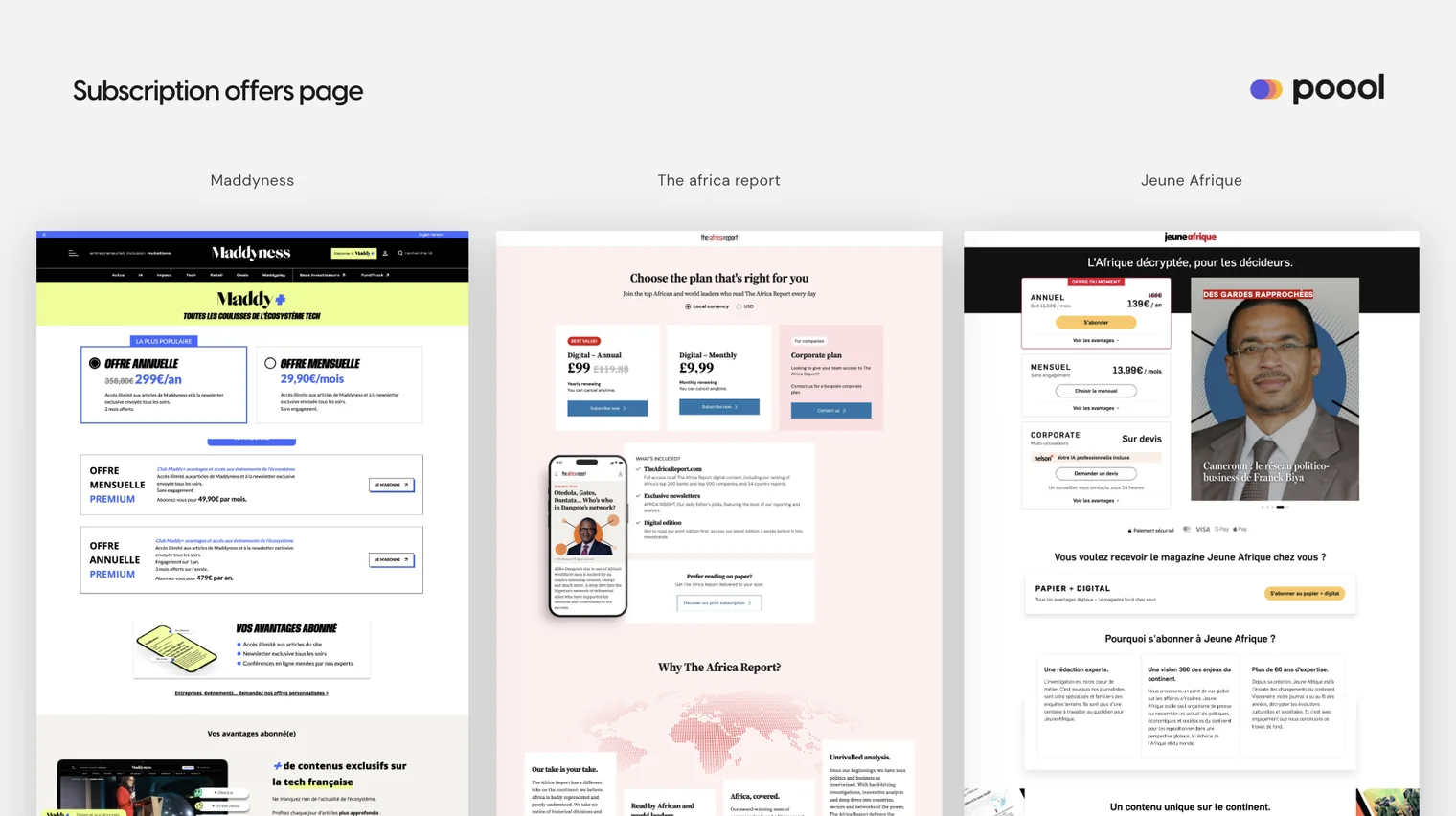
Start with the basics that the best offers pages share. Maddyness, The Africa Report and Jeune Afrique all highlight one offer, usually the annual plan, with the savings shown against the monthly price. They keep the choice to a handful of plans, spell out what subscribers get, and give readers who need it a way to a corporate or a print offer. The Africa Report lets readers switch to their local currency, and Jeune Afrique shows the payment methods its readers use. Audiencers' own subscription page is another example to look at.
Then make it dynamic. Jeune Afrique built its offers page on the same segments as its paywall, adapting the currency, payment methods, message and length of commitment for each one. Der Spiegel found that the more engaged readers are, the more interested they are in longer, discounted offers, while occasional readers convert better with low-barrier offers but stay less long. Spektrum found that most segments preferred a short offers page, except its print magazine subscribers, who converted better with more detail. And Les Echos works with 12 personas, with the aim of showing each one only the three benefits that matter most to it.
With Poool, you can build your offers and landing pages and make them dynamic with the same targeting as your paywall: different offers, prices, messages and benefits for each segment. You set the offers and prices, Poool shows the right one to each reader, and checkout stays in your subscription platform.
Use your own data
Every page view triggers a real-time decision in Poool, combining user, session, context and your own data. You can use 30+ Poool targeting options, or your own segments and scores from your CDP or CRM: some customers push around 150 variables into Poool to target their journeys. NTM, for example, personalises its paywall journey with its own data (ad revenue potential, content performance, RFV) pushed into Poool.
Test, don't guess
Every publisher in this article got to its results by testing, and by measuring more than the click: Handelsblatt judges each segment on long-term revenue, not just conversion. With Poool, you can A/B test two scenarios in two clicks, with an adjustable audience split. Using Poool's A/B testing and the support of Poool's customer success team, The Africa Report almost doubled its paid subscribers.
What publishers achieved with Poool
- Using Poool, Jeune Afrique lifted conversion by 30% with its dynamic paywall, then doubled the conversion rate of its offers page.
- Using Poool, ELLE.fr raised its paywall conversion rate by 20% in Q4 2024 with contextual paywalls by section.
- Using Poool, EBRA increased click-through rates by 97% and conversion rates by 37% with an offer wall tested on one brand.
- Using Poool, Les Echos increased its conversion rate by 50% in 6 weeks.
- Using Poool, Alternatives Économiques raised its paywall conversion rates by 40% with a one-click payment wall.
Poool's MCP
Build every version of your paywall in minutes
A dynamic paywall means several versions to design, build and keep up to date. With Poool's MCP, you can build them from your own AI assistant, in minutes and without a developer. Share a Figma file, a URL or a screenshot, ask for a paywall or an offers page, and it builds it based on what already works for publishers: 10 years of experience with 250+ publishers and Audiencers' analysis of 1,000+ more. Your team reviews, adjusts and decides what goes live.
Want to see what it would build for you? Book a demo to run your current paywall through Poool's MCP.